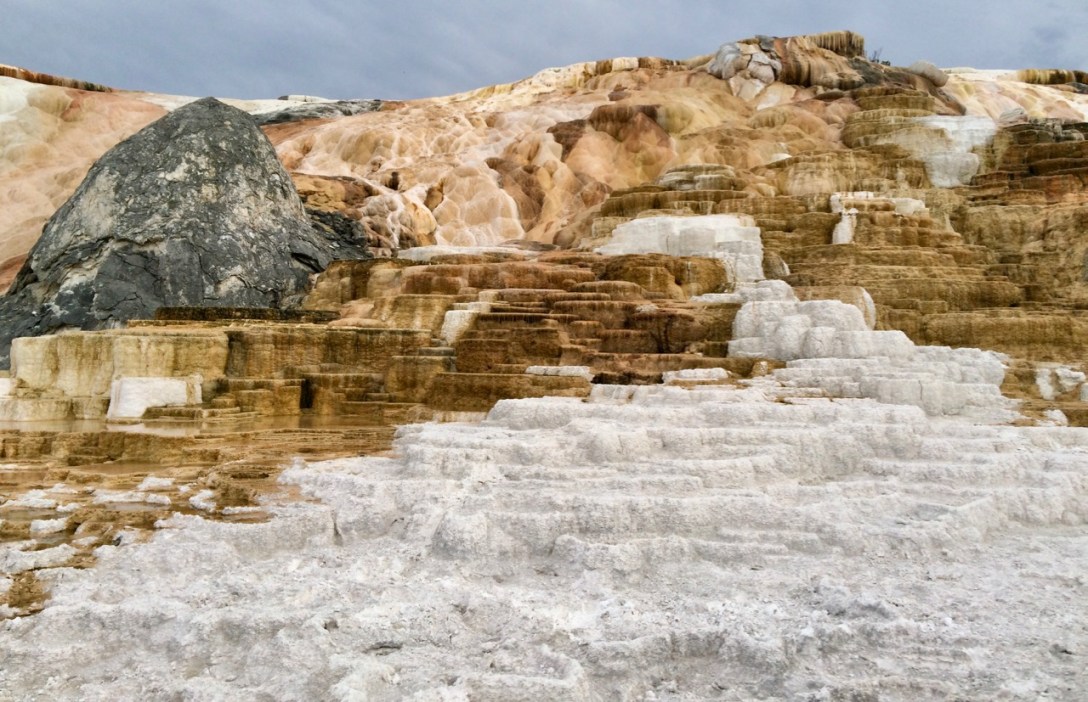
Pic: What on Earth? Palette Spring. Mammoth Hot Springs, Yellowstone NP, WY
Yellowstone is so gigantic that after five days I had barely made a dent — and had yet to see the park’s most famous feature. So, recharged from a few nights in a soft bed, I went back for seconds. With the 4th of July holiday weekend approaching, I walked into the backcountry office with some anxiety.
“This might be a stupid question but… are there any backpacking sites available this week near Old Faithful?”
Clickity-click. “No problem. How’s Thursday and Friday night?”
Boom!
That left me one night to fill. I was headed back toward Gardiner to scout for something in the neighboring National Forest when I noticed something wrong with the sign by Mammoth Campground: it didn’t say CAMPSITE FULL.
I made a hasty left, parked near the entrance, and approached the camp host.
“This might be a stupid question but… do you have a site for tonight?”
“Yup, we’ve got a few.”
Boom!
Sleeping arrangements arranged, I was free to splash around in the Gardner River[1] where I met this handsome fellow:
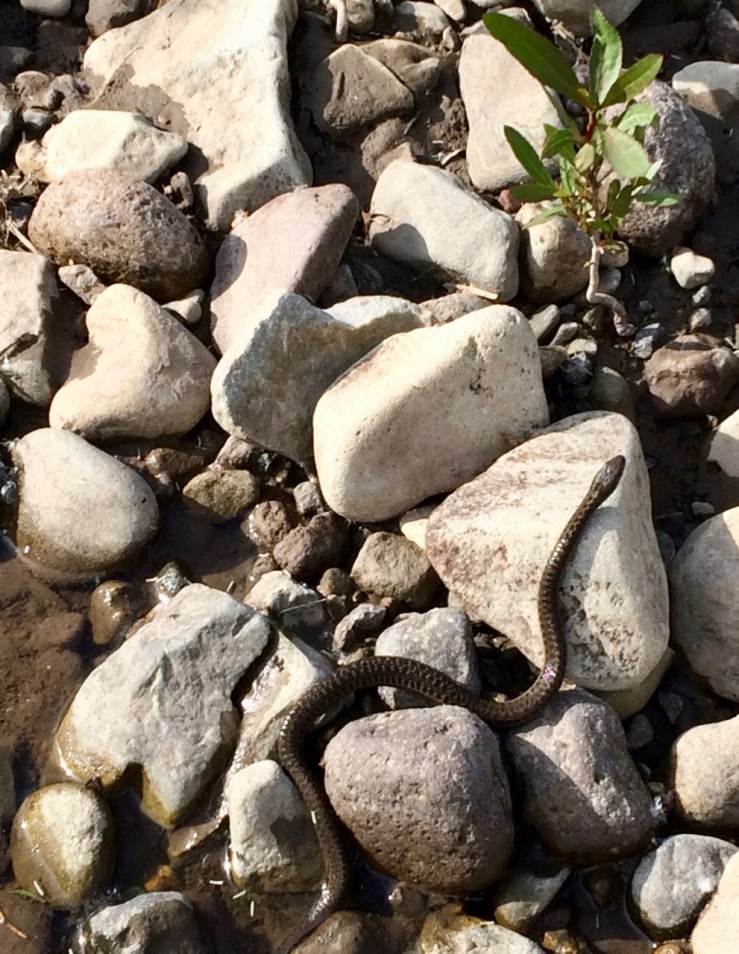
Pic: Terrestrial gartersnake. Gardner River, Yellowstone NP, WY
Then I explored the famous Mammoth Hot Springs, where I met this other handsome fellow:

Pic: Bullsnake. Mammoth Hot Springs, Yellowstone NP, WY
And these otherworldly (there’s that word again) formations:

Pic: Seriously: What on Earth? Minerva Terrace. Mammoth Hot Springs, Yellowstone NP, WY
Readers may be asking themselves something that feels like a stupid question: what on Earth is happening at Mammoth Hot Springs?
As is often the case in Yellowstone, the answer is a unique combination of geology, chemistry, and biology. The terraces, stark white when uncovered, are travertine — dissolved and re-deposited limestone. The rich oranges and browns are mats containing billions of thermophilic bacteria and illustrate the different temperatures of magma-heated water welling up from below[2].
[1] The nearby town is named Gardiner but the river is spelled Gardner in most (but not all) sources. /shrug
[2] This My Yellowstone article has a good summary.
 Danger Beyond This Point