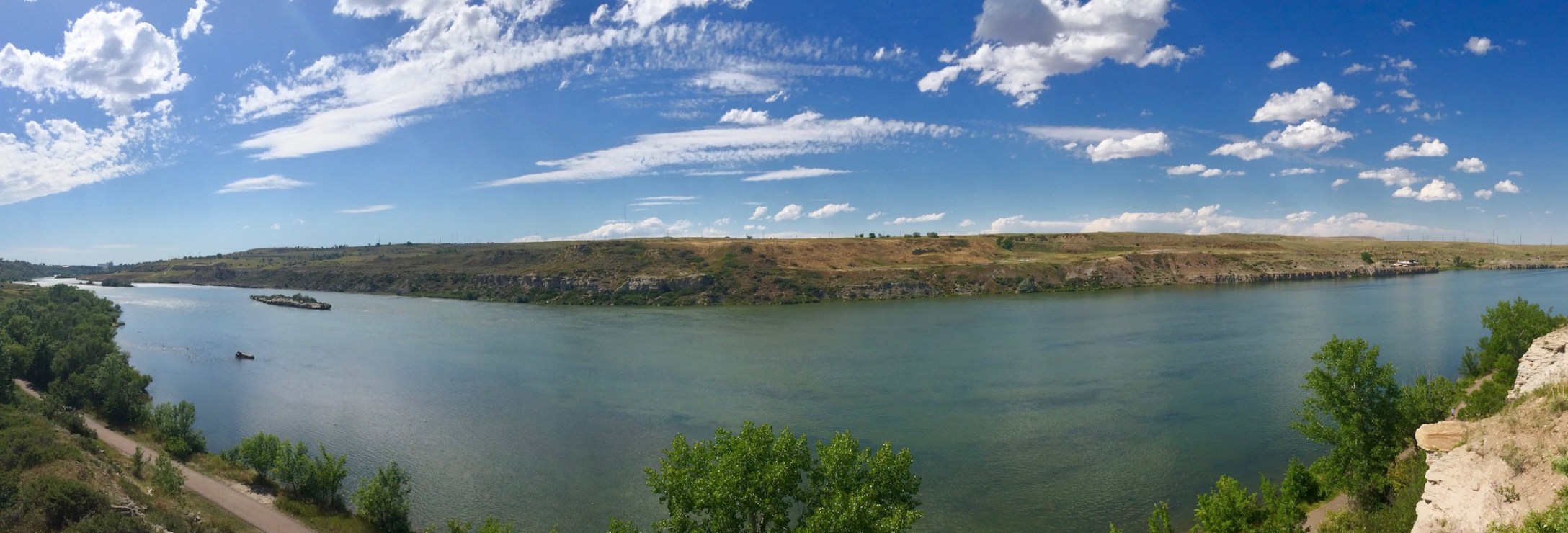
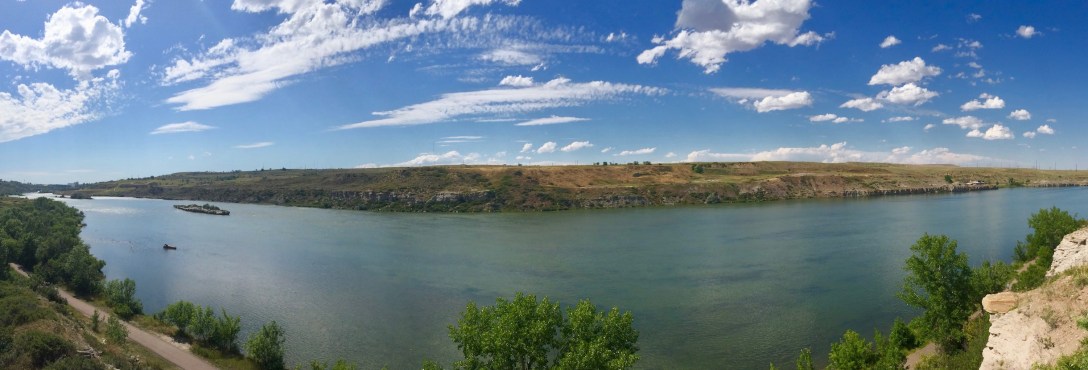
Pic: The mighty Missouri River. Lewis & Clark Interpretive Center, Great Falls, MT. Larger image
Like many Americans, I had heard of Lewis and Clark and their famous 1804 journey into the newly-acquired Louisiana Purchase[1]. And, like many Americans, I knew little else about the matter. My interest grew as I saw their names, Thomas Moran-like, attached to highways[2] and roadside souvenir shops and show caves throughout Montana.
I must have mentioned my curiosity to someone on a trail or at a lunch counter because an uncredited stranger suggested I check out the Lewis and Clark Interpretive Center on my way to Glacier. Great Falls itself was not particularly memorable — my notes mention only that it was “balls hot” — but the Interpretive Center was one of the indoor highlights of the trip.
The museum was thoughtfully laid out, leading from the political and economic motivations for the Corps of Discovery Expedition, through the hardships the team faced in a vast and indifferent wilderness, to the impact of their discoveries on the fledgling United States and its contemporaries. It discussed the Corps’s confrontations and collaborations with the native people during their journey to the headwaters of the Missouri River and beyond. It recounted the time Lewis almost got his ass kicked by a grizzly bear but then fended it off by standing in the middle of a river with a spear. It told of Sacagawea and her friend Naya Nuki, whose namesake peaks I’d hiked the week before.
I learned all this and more, but here are three of my favorite Lewis and Clark facts:
3. The expedition included an African-American named York. A slave owned by Clark, York’s story is largely lost to history. We know that he enjoyed many of the same freedoms as the men he worked alongside in the North American hinterlands, but was forced back into a slave’s life when the group returned to civilization.
Anyway, some of the first Indians the group encountered had never seen a black person; when they met him, they tried to rub the paint off his skin. The novelty of York’s appearance proved useful in breaking the ice with the locals.
2. The Interpretive Center is located at Great Falls because this is where the crew, rowing their heavy, gear-laden boats up the Missouri, found their route blocked by a half-dozen waterfalls rising 800 feet over the next fourteen miles of river. With winter in the Rockies only a few months away and no time to seek an alternate route, the men spent weeks hauling their boats and equipment up the steep, V-shaped sides of the valley, an event now memorialized as the Great Falls Portage.
1. Lewis and Clark kept meticulous records. Their detailed maps “provided the first accurate depiction of the relationship of the sources of the Columbia and Missouri Rivers, and the Rocky Mountains”.[3] They described flora and fauna and brought specimens back to Washington. But best of all, they journaled.
They wrote about everything: fights with horse thieves[4], the place where they ran out of butter[5], and — still the bane of outdoors enthusiasts two hundred years later — mosquitoes. Neither man had much formal education and written English was less formalized at the time, so some of the spelling is quite creative:
“Clark came up with no fewer than 19 variations, including mesquestors, misquestors, misquitor, misquitoes, misquitors, misqutors, misqutr, missquetors, mosquiters, mosquitors, mosquitos, muskeetor, musqueters, musquetors, musquiters, musquitoes, musquitors, musqueters, and musqutors.”
—Lewis & Clark Versus the Mosquito
It’s not really fair given all they accomplished, but for me William Clark will forever be “the guy who wrote about ‘musquetors'”.
[1] Better known today as the midwestern states, North Dakota and Minnesota to Texas and Louisiana. Better known to the people Lewis and Clark encountered as “the place our families have lived for generations”.
[2] “US 12 in Montana has been defined as the Lewis and Clark Highway, despite not being the route followed by Lewis and Clark across the state.” #fakenews
[3] Wikipedia
[4] “July 27th 1806 Sunday”, Meriwether Lewis
[5] This one is also a great example of how the group named the geographic features they found: “I call this Island Butter Island, as at this place we mad[sic] use of the last of our butter…” —“July 19th Thursday 1804”, William Clark
 Danger Beyond This Point