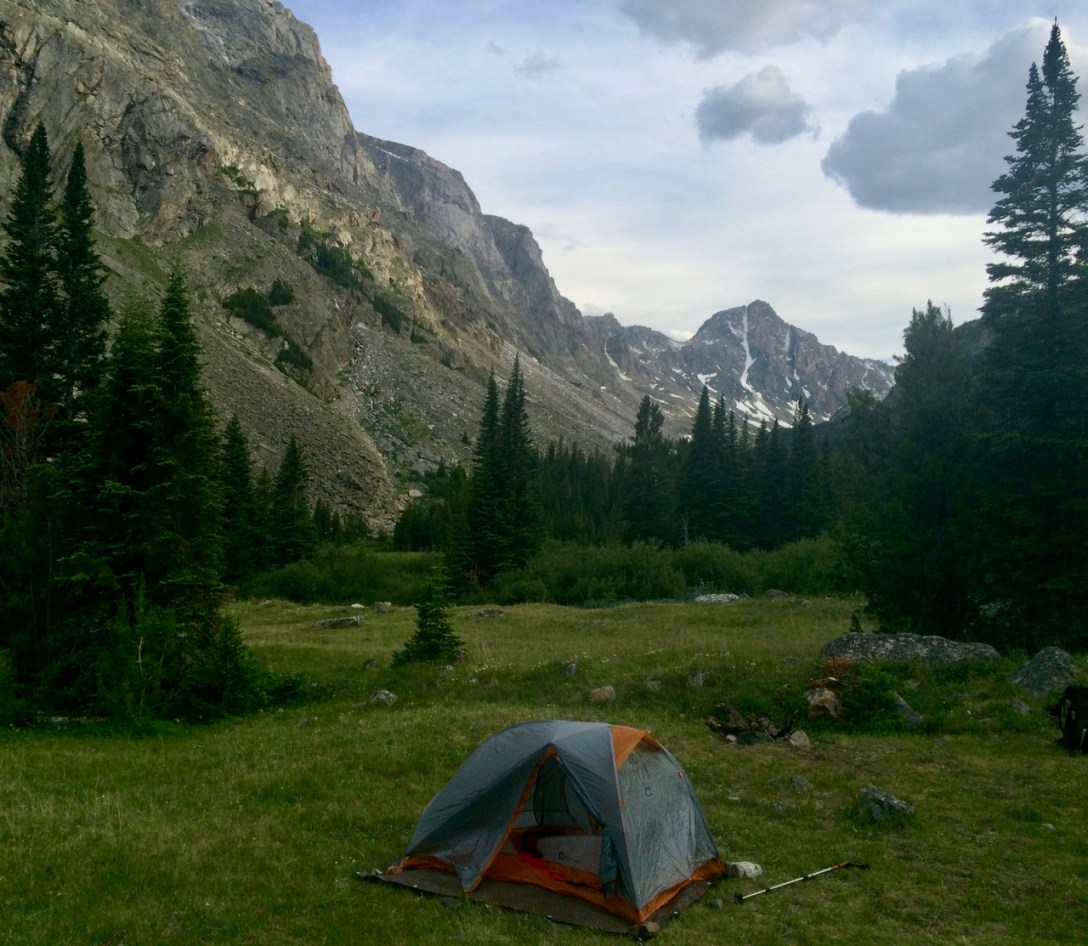
Pic: My bedroom and Whitetail Peak. If you, like me, noticed the white ribbon bisecting the mountain and half-jokingly wondered, “Is that line skiable in the summer?” the answer is gnar. Quinnebaugh Meadows, Custer Gallatin NF, MT
The only thing visitors to the Yellowstone area want to see more than Old Faithful is a bear. And with good reason: by turns fearsome and adorable, cunning and clumsy, bears are freaking awesome.
However, all wild animals deserve respect: they are comprised entirely of muscle, teeth, antlers, and/or claws because nature does not mess around. To this roster bears add the keenest sense of smell in the animal kingdom, intense curiosity, and powerful food-seeking instincts. Grizzlies, bears that can weigh up to 700 pounds and which are notorious for their unpredictability, are the indisputable rulers of North American fauna.
Hence, the forest and park services try to impress upon visitors the importance of safety while traveling in bear country. They post signs about recent bear activity. There are brochures in every ranger station, handouts when you enter Yellowstone, and numerous articles on the website. Bear cans are mandatory in many backcountry areas and backpackers answer a questionnaire about bear awareness when getting a wilderness permit.
Consequences for failure are serious. Every once in a while, a North American bear kills someone. More often, a bear that grows accustomed to humans — and especially to human food — becomes a “problem bear”.
Remember the reported grizzly sighting from yesterday? I stopped by the trailhead in the morning to take advantage of the luxurious vault toilet there and found a ranger turning away would-be hikers. He explained that the bear spotted yesterday, a young male well-known in the area, had shown increasingly aggressive behavior and the trail was closed while Fish and Wildlife addressed the situation.
“Are they going to relocate him?” I asked.
“Nope.”
“…oh.”
The result was that I, a safety- and animal-conscious user of public lands, became kind of paranoid about bears. I knew negative bear encounters, while rare, happened more frequently with individuals than with groups. So, I carried — and slept with — bear spray religiously. I exercised my decidedly mediocre singing voice, especially in areas with low visibility. I learned to call out, “Hey Bear!” before rounding corners like they do in the orientation video (though I never learned to not feel dumb doing so).
I explain all this so you understand how I felt when, as I scouted the meadows for a spot to set up camp, I turned and saw a bear 75 yards away.
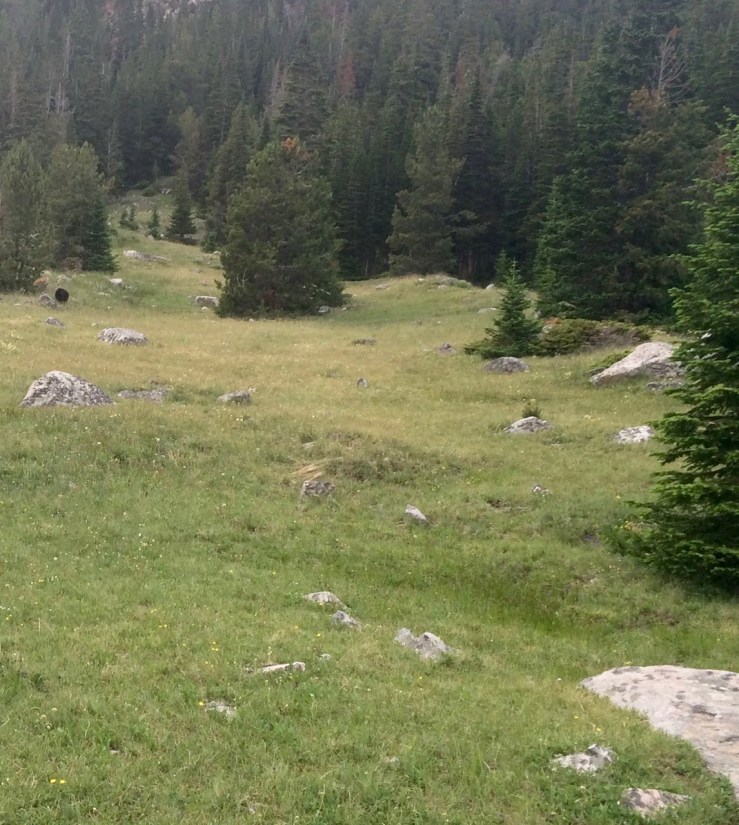
Pic: It’s comin’ right for us! Black bear (middle left), Quinnebaugh Meadows, Custer Gallatin NF, MT
“No way!” I whispered excitedly. I dropped my trekking pole and snapped a few terrible pictures, the least terrible of which is above. I’d had better views from zoos and nature documentaries, but nothing compares to the magic of being with a large animal on its home turf.
The moment proved short-lived, though, as the bear started moving down the hill in my direction. Before it could take two steps, my education kicked in and I shouted, “HEY BEAR! GET THE FUCK OUT OF HERE!” The bear did exactly what non-habituated bears are supposed to do when confronted with a noisy, smelly human: it sniffed the air a bit, then turned and ran away.
My first real bear encounter was so brief that I didn’t get a positive species ID. Its fur was black, but it seemed pretty big to be a black bear. Not that fur color or size are good identifying characteristics, but with the distance and angles involved I couldn’t tell whether the bear’s facial profile was “dished” or how long its front claws were[1]. Regardless, the experience was such a rush that I had trouble falling asleep that night, giggling like a schoolboy whenever I thought of my four-legged neighbor.
[1] If you think you’re a hotshot differentiator of American bear species, prove it by taking the Montana Fish, Wildlife, and Parks Department’s Bear Identification test.
 Danger Beyond This Point